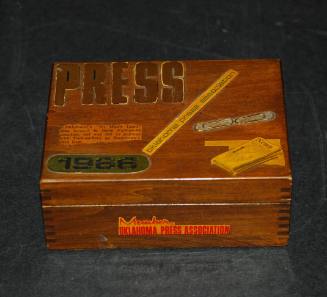
Box
Object number2021.146.1 a-j
Manufacturer
Breyer Molding Company
Datec. 1999
OriginUnited States of America
OriginChina
MediumWood; Plastic; Paper; Ink; Adhesive; Glass; Metal; String; Fabric
Credit LineGift of Carol Pursehouse
DescriptionKeepsake box with cross necklace, horse finger puppet, six miniature model horses, and sheet of temporary tattoos.
Keepsake box. Rectangular wooden box covered in applied paper with polychrome scenes of rural landscapes with horses, barns, houses, flowers, and trees. Clamshell lid has gold metal latch on front and two metal hinges along back edge. Underside is white with gold oval maker sticker in back proper left corner. Interior is white with rectangular mirror inside lid and two shelf supports inside bottom, shelf is not intact.
Cross necklace. Semi-transparent fluorescent orange plastic cross with beveled edges and hole at top center. Base of cross has maker symbol and side of base has place of manufacture. Fluorescent orange string tied through hole at top of cross and knotted together at the ends.
Horse finger puppet. Plush brown horse with black plastic eyes and black plush nose, mane, and tail. Rear of horse has hole lined with white fabric for use as finger puppet. Horse's belly has handwritten black ink initials. Received inside box.
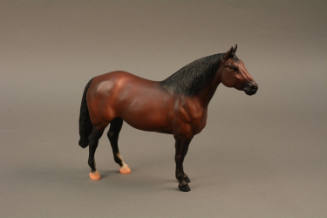
Miniature horse model. Brown molded plastic horse with front left white sock. Horse's head is bent down and its mouth is touching its bent rear right leg's hoof. Horse's belly has raised maker text and black ink marking. Slightly larger than the other horses.
Miniature horse model. Black molded plastic horse with white star on head and rear right white pastern. Horse's front left leg is slightly raised. Horse's belly has raised maker text.
Miniature horse model. Brown molded plastic horse with white blaze on face; black nose, mane, tail, and fore stockings; and rear white pasterns/socks. Horse is seated on its rear. Horse's belly has raised maker text.
Miniature horse model. Light brown molded plastic horse with white blaze on face; off-white mane and tail; and front left white sock. Horse is seated on its rear. Horse's belly has raised maker text.
Miniature horse model. Brown molded plastic horse with white spots on back; black mane and tail; and front left white pastern. Horse's head is bent down. Horse's belly has raised maker text.
Miniature horse model. Light brown molded plastic horse with white blaze on face with black star at top; white spots on back and neck; black mane and tail; and front right and rear white pasterns. Horse's front left leg is raised slightly. Horse's belly has raised maker text and black ink marking.
Sheet of temporary tattoos. Sheet is covered in rectangular clear plastic sheet. Tattoo sheet is missing viewer's right half. Tattoo sheet paper has white background and images of four horses, clockwise from top left: brown horse facing viewer's right, black horse facing front, brown horse facing viewer's left, and white horse facing front. Reverse has printed gray images of same horses overlaid by directional and maker text.DimensionsHeight x Width x Depth (a - closed): 3.938 x 8 x 4.063 in. (10 x 20.3 x 10.3 cm)Height x Width x Depth (a - open): 6.75 x 8 x 6.875 in. (17.1 x 20.3 x 17.5 cm)
Height x Width x Depth (b - overall): 15 x 1.5 x 0.25 in. (38.1 x 3.8 x 0.6 cm)
Height x Width x Depth (b - cross only): 2 x 1.5 x 0.25 in. (5.1 x 3.8 x 0.6 cm)
Height x Width x Length (c): 2.75 x 2.5 x 4.625 in. (7 x 6.4 x 11.7 cm)
Height x Width x Length (d): 1.688 x 0.75 x 1.75 in. (4.3 x 1.9 x 4.4 cm)
Height x Width x Length (e): 1.125 x 0.313 x 1.25 in. (2.9 x 0.8 x 3.2 cm)
Height x Width x Length (f): 0.938 x 0.625 x 1.125 in. (2.4 x 1.6 x 2.9 cm)
Height x Width x Length (g): 0.875 x 0.5 x 1.188 in. (2.2 x 1.3 x 3 cm)
Height x Width x Length (h): 0.875 x 0.5 x 1.25 in. (2.2 x 1.3 x 3.2 cm)
Height x Width x Length (i): 1.125 x 0.313 x 1.188 in. (2.9 x 0.8 x 3 cm)
Height x Width x Depth (j): 2.5 x 3.5 x 0.063 in. (6.4 x 8.9 x 0.2 cm)
Inscriptions(c)
Horse's belly has handwritten black ink initials "Df".
Marks(a)
Underside has gold oval maker sticker in back proper left corner with black border and printed text "MADE IN / CHINA".
(b)
Base of cross has raised maker symbol and side of base has raised text "CHINA".
(d)
Horse's belly has raised maker text "©1999 / BREYER / REEVES".
(e)
Horse's belly has raised maker text "©BREYER".
(f)
Horse's belly has raised maker text "©BREYER / 24".
(g)
Horse's belly has raised maker text "©BREYER / 24".
(h)
Horse's belly has raised maker text "©BREYER / 3".
(i)
Horse's belly has raised maker text "©BREYER".
(j)
Reverse has printed black text including OOS TM DIRECTIONS: / ... / ...Made in the U.S.A. / [ingredients] / ANI-8; proper left half of sheet is missing.
Historical NotesPart of a collection of objects that belonged to Daniel Flavin. Daniel Flavin was born to Francis and Margaret Byrne Flavin on May 3, 1946. A native of Shaler Township, Pennsylvania., Daniel was the fifth of seven siblings. Daniel had five sisters (Carol Flavin Pursehouse, Catherine Flavin Haddock, Virginia Flavin Pribanic, Margaret Flavin Patanu, and Mary Lou Flavin Brock) and a brother who died in infancy. Daniel was referred to as “Danny Boy” by the Flavin family. Frank Flavin operated a grocery store in Lawrenceville and later worked as a parking lot attendant. He was also an amateur boxer, known for his physical fitness. Frank Flavin leveraged his physical fitness to help Daniel learn to walk as a toddler. Shortly after Daniel was born, he was diagnosed with a genetic disorder that resulted in an intellectual disability and doctors gave him a poor prognosis, believing that he would not live beyond four years. He grew up in an era with few services for children with intellectual disabilities. Nevertheless, the Flavins decided to raise their son at home amid a loving family. He attended a special class at the Sample Elementary School in nearby Millvale. Margaret would transport Daniel via taxi to the school. Upon the arrival of Daniel’s youngest siblings Virginia and Cathy, Margaret was unable to frequently transport Daniel to Sample School. At times, Daniel was called derogatory names by fellow neighborhood children. Daniel was known for his passion for horses and frequently wore cowboy hats. He enjoyed books on horses and toy cars. He was known for his pleasant demeanor. He also loved to eat and drink pop. He also loved Christmas, playing with Etch-A-Sketches, and dancing. Daniel had a limited vocabulary and frequently communicated with hand motions. In 1961, when Daniel was 15, he was institutionalized at Polk Center. Daniel was on the waitlist for Polk Center for six years before being admitted. When Dan moved to Polk Center, there were more than 3,000 residents. This was because he had developed aggressive behaviors and his mother had encountered mental health challenges that resulted in her hospitalization for several weeks, according to interview with the sisters. His violent behavior, brought about by puberty, “overwhelmed the family,” they said. Daniel’s physical safety, as well as others’, became a concern and doctors recommended that he be institutionalized. This transition was difficult for all family members. Throughout his life, Daniel would frequently say “home” when his family members came to visit him. For many years after moving to Polk, Daniel returned home in the summers and for holidays and weekends. Family also made frequent visits to Polk. The family would frequently take Daniel on picnics to Sandy Lake, Pennsylvania. They were satisfied with Daniel’s care and found that it provided something that had been missing at home in Pittsburgh, where there were limited community-based supports, particularly during his adolescence. Polk Center staff was very fond of Daniel, who was known for his pleasant demeanor. He often greeted individuals in the hallways of Polk Center by saying “Hi Buddy.” Over 40 years, the sisters witnessed changes at Polk Center that reflected broader changes in the way people provided care to people with disabilities. For example, when Dan entered Polk, staff wore uniforms that reminded the sisters of the “military-like” efficiency of the care. Later, caregiving became more relaxed with staff wearing jeans and other casual attire. Following the U.S. Supreme Court’s Olmstead Decision in 1999, which ruled that unjustified segregation of people with disabilities in institutions and nursing homes is a violation of Title II of the Americans with Disabilities Act, the Pennsylvania Department of Public Welfare facilitated the transition of state institution residents to community-based group homes. The Flavin family did not want Daniel, then in his early 50s, to leave Polk. They filed a lawsuit that led to a law that allows families to have a say in residential placement. They also advocated for institutions to stay open. After Daniel’s death, the sisters continue their support of Polk Center. For the past 25 years, they have collected slightly used clothing and given it as gifts to Polk residents. They also bring Santa Claus. Daniel Flavin died on June 8, 2018.
Previous owner
Daniel Flavin
(1946 - 2018)
Related person
Francis Flavin
Related person
Margaret Byrne Flavin
Related institution
Polk State Center
(founded 1897)
Related institution
Sample Elementary School
On View
Not on view


L.E. Smith Glass Company

1973-1974