


Wall
Object number2024.96.1 a-n
Artist
Jack Nofsinger
Date1940-1949
MediumWood; Plywood; Oil paint; Paint; Metal; Ink; Stain/Varnish; Chalk(?); Adhesive tape
Credit LineGift of Tom Binz
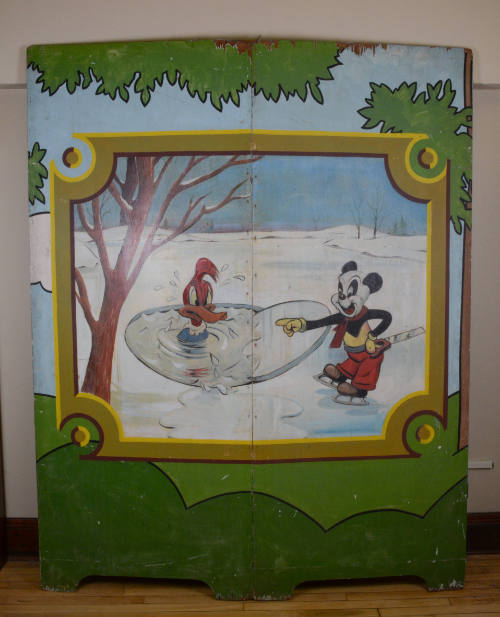
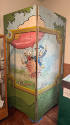
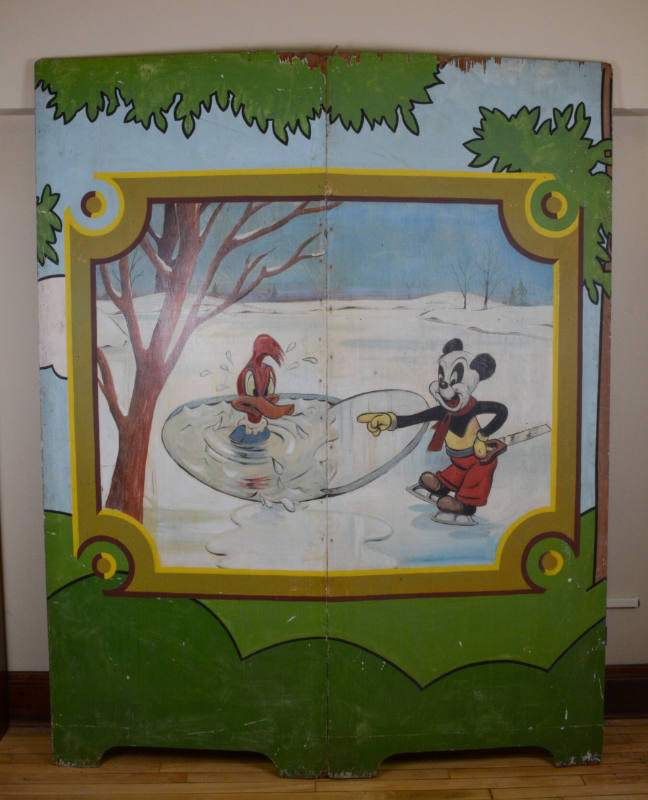
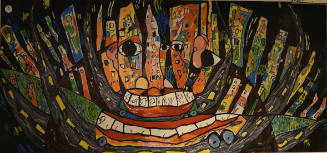
DescriptionSet of fourteen (14) carousel scenic wall panels that form seven (7) scenes of Walt Disney stories, cartoon characters, and other fairytale scenes including Woody Woodpecker, the Three Little Pigs, Pinocchio, Bambi, Mickey Mouse, Donald Duck with Huey, Dewey, and Louie, and Peter and the Wolf.
Each scenic pair is comprised of two rectangular plywood panels that join via two metal hinges along reverse center. The seven pairs would have originally been connected together in a large tetradecagon.
Front of panels are painted with central scene of cartoon characters framed with brown and gold rectangular frame with a circle in each corner. Panels have painted perimeter of variegated green hills, clouds, and trees. Bottom of each panel have two integral feet. Reverse are stained/varnished dark brown and have perimeter frame. DimensionsHeight x Width x Depth (a-b together): 90.125 x 71.75 x 3.5 in. (228.9 x 182.2 x 8.9 cm)Height x Width x Depth (a): 90.125 x 37.375 x 1.75 in. (228.9 x 94.9 x 4.4 cm)
Height x Width x Depth (b): 91.5 x 36.125 x 1.75 in. (232.4 x 91.8 x 4.4 cm)
Height x Width x Depth (c): 90.75 x 38.25 x 1.875 in. (230.5 x 97.2 x 4.8 cm)
Height x Width x Depth (d): 90.125 x 35.75 x 1.5 in. (228.9 x 90.8 x 3.8 cm)
Height x Width x Depth (e): 90.125 x 35.875 x 1.5 in. (228.9 x 91.1 x 3.8 cm)
Height x Width x Depth (f): 90 x 38.25 x 1.875 in. (228.6 x 97.2 x 4.8 cm)
Height x Width x Depth (g): 90 x 37.25 x 1.75 in. (228.6 x 94.6 x 4.4 cm)
Height x Width x Depth (h): 90 x 37.25 x 1.75 in. (228.6 x 94.6 x 4.4 cm)
Height x Width x Depth (i-j together): 90.125 x 71.75 x 3.5 in. (228.9 x 182.2 x 8.9 cm)
Height x Width x Depth (i): 90 x 35.875 x 1.75 in. (228.6 x 91.1 x 4.4 cm)
Height x Width x Depth (j): 90.125 x 36.125 x 1.75 in. (228.9 x 91.8 x 4.4 cm)
Height x Width x Depth (k-l together): 90.125 x 71.75 x 4.5 in. (228.9 x 182.2 x 11.4 cm)
Height x Width x Depth (k): 90.125 x 36.125 x 2.5 in. (228.9 x 91.8 x 6.4 cm)
Height x Width x Depth (l): 90.125 x 35.875 x 1.875 in. (228.9 x 91.1 x 4.8 cm)
Height x Width x Depth (m-n together - Approximate): 90.125 x 71.75 x 3.5 in. (228.9 x 182.2 x 8.9 cm)
Height x Width x Depth (m - Approximate): 90 x 37 x 1.75 in. (228.6 x 94 x 4.4 cm)
Height x Width x Depth (n - Approximate): 90 x 37 x 1.75 in. (228.6 x 94 x 4.4 cm)
Inscriptions(a)
Front of panel has graffiti text handwritten in black ink inside a speech balloon in front of Woody Woodpecker "You FAgot".
Reverse has handwritten partial number "2" in white at top center, possibly written in chalk.
Reverse has number handwritten in either graphite or ink in top proper left corner "5" and top proper right corner "6".
(b)
Front of panel has illegible graffiti text handwritten in black ink inside a speech balloon in front of Andy Panda, text possibly reads "HA / HA / HA / HA".
Reverse has number handwritten in either graphite or ink in top proper left corner "4" and top proper right corner "5".
(c)
Reverse has number handwritten in either graphite or ink in top proper right corner "14".
(d)
Front of panel has illegible graffiti text handwritten in black ink on the front pig's forehead.
Reverse has number handwritten in either graphite or ink in top proper left corner "12" and top proper right corner "13".
(e)
Reverse has number handwritten in either graphite or ink in top proper left corner "9" and top proper right corner "10".
(f)
Reverse has handwritten number "9" in white at top center.
Reverse has number handwritten in either graphite or ink in top proper left corner "8" and top proper right corner "9".
(g)
Reverse has handwritten number "12" in white at top center.
Back of panel has handwritten text in blue near center "MAC".
Reverse has number handwritten in either graphite or ink in top proper left corner "11" and top proper right corner "12".
(h)
Front of panel has graffiti text handwritten in black ink inside a speech balloon in front of Flower "YUM".
Reverse has handwritten number "11" in white at top center.
Reverse has number handwritten in either graphite or ink in top proper left corner "10" and top proper right corner "11".
(i)
Reverse has handwritten number "8" in white at top center, possibly written in chalk.
Reverse has number handwritten in either graphite or ink in top proper left corner "7" and top proper right corner "8".
(j)
Front of panel has graffiti text handwritten in black ink inside a speech balloon in front of Donald Duck "HASH / BROWNIES?".
Reverse has handwritten number "7" in white at top center, possibly written in chalk.
Reverse has number handwritten in either graphite or ink in top proper left corner "6" and top proper right corner "7".
(k)
Reverse of door has handwritten number "18" in white at top center, possibly written in chalk.
Reverse of door has handwritten text in black ink at center "KEEP / OUT / THIS / MEANS / YOU".
(l)
Reverse has handwritten graffiti text in black ink at proper right center that is difficult to read "PULL / 440 / EACH / NIGHT".
Historical NotesPainted wood panels from the carousel at West View Park in Pennsylvania. The panels, which are believed to date to the 1940s, encircled the inner section of the ride where the organist played. The panels were painted by Jack Nofsinger. T. M. Harton and Fredrick Henninger opened West View Park in 1906. After the first season, Henninger sold his part of the company to Harton and became a partner at Kennywood Park, West View Park's main competitor in the Pittsburgh area. Harton continued adding attractions and rides, such as The Dips, a Ferris Wheel, and the Speed-O-Plane until his death in 1919. After a dispute over Harton's will, his sister, Olive Harton Jones, took control over the park and continued adding rides throughout the 1920s. During the 1930s ridership decreased, and the ballroom became the main attraction at the park, becoming the park's main source of income. Dancing was still a big attraction during World War II, but ridership increased as servicemen home on leave took advantage of the park's free admission for them. With the exception of adding a few rides, the park remained at a standstill until the end of the war and change of ownership. George Harton III, T. M. Harton's nephew, took over the park in 1945, and immediately began making changes. The ballroom was remodeled and renamed Danceland. The newly air-conditioned ballroom continued to be an attraction, as well known musicians, such as Tommy Dorsey, were booked to perform. George Harton III continued to improve the park with new rides and attractions until his death in 1966. Although his mother took control of the park after Harton's death, no one in the family was involved in the park's day-to-day business, and few improvements were made. No longer able to compete with Kennywood and other parks in the region, West View Park closed after its 1977 season.
Related institution
The Walt Disney Company
Related institution
West View Park Company
On View
Not on view



Dr. A. C. Daniels, Inc.
c. 1917